




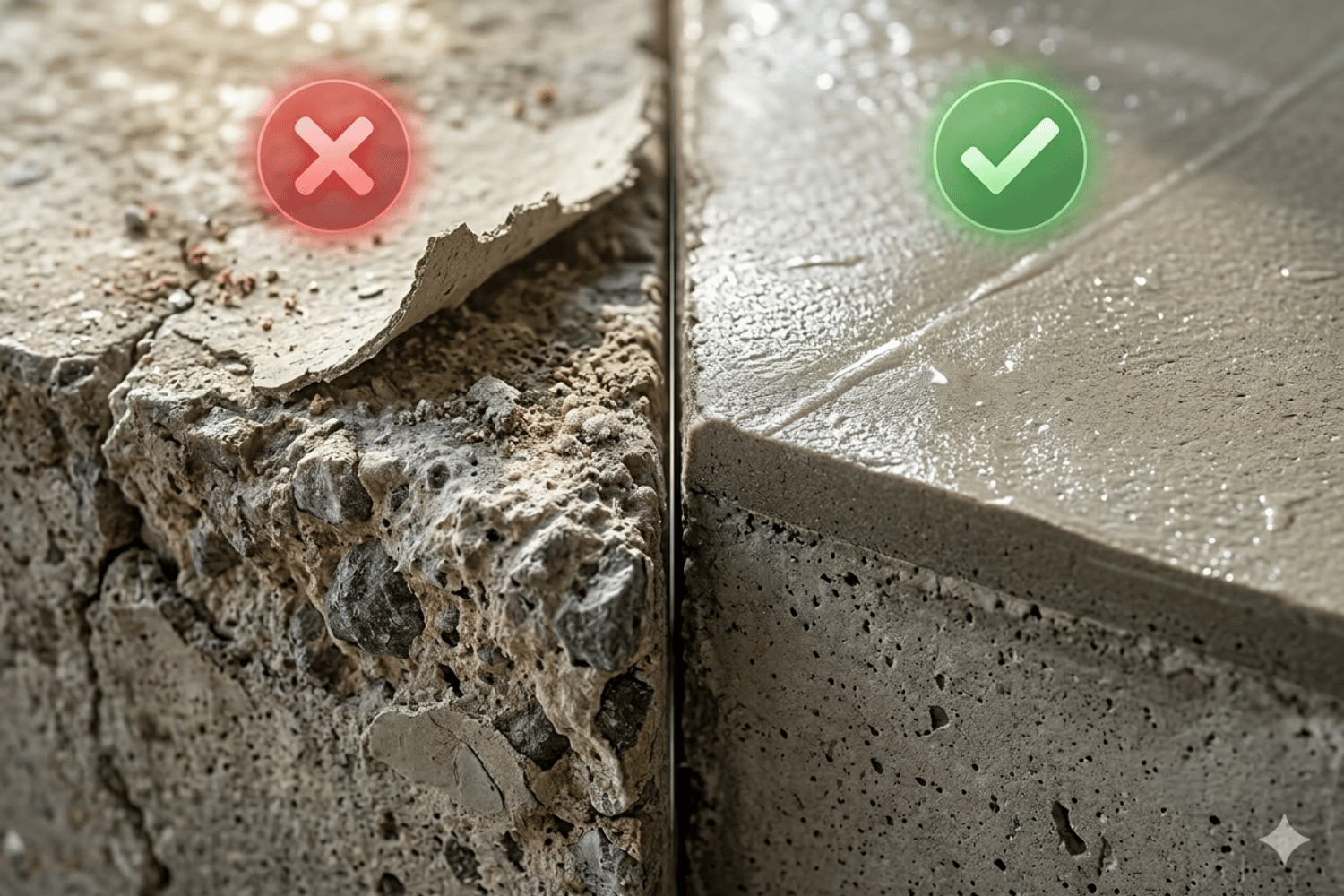
Cracks, surface deterioration, and concrete loss that occur in concrete structures over time are often repair mortar applications. However, a common problem encountered in the field is that the repair mortar separates from the surface shortly afterward. This is generally an adhesion problem and is one of the most critical errors in the application of construction chemicals.
Adhesion, meaning the repair mortar's ability to adhere strongly to the existing concrete surface, is a fundamental requirement for a successful repair. If the repair mortar does not bond sufficiently to the surface, the application may blister, crack, or completely detach over time.
The Most Common Causes of Adhesion Problems
In concrete repair applications, adhesion problems often stem from application conditions rather than product quality. Some of the most common causes encountered on construction sites include:
Insufficient surface preparation
The concrete surface to which repair mortar will be applied may contain dust, oil, loose concrete particles, or form oil residue. Such contaminants severely reduce the adhesion of the repair mortar to the surface. Applications made without first ensuring the concrete surface is sound and clean are generally not long-lasting.
No primer or binder is used
Many concrete repair systems of primers . These products create a bond between the old concrete and the newly applied repair mortar. Adhesion values can be significantly reduced in applications where a primer is not used.
Extremely dry or extremely damp surface
The moisture content of the concrete surface also directly affects adhesion. Very dry surfaces can quickly absorb water from the repair mortar. This negatively impacts the hydration process of the mortar, making it difficult for it to adhere to the surface.
On the other hand, the presence of free water on the surface can also cause a weak layer to form between the repair mortar and the concrete.
Choosing the wrong repair mortar
Not every concrete repair requires the use of the same product. Different technical mortars and repair mortars have been developed for fine surface repairs, deep concrete repairs, or structural reinforcements. Choosing the wrong product can directly reduce adhesion performance.
What should the correct application be?
To achieve successful results in concrete repair applications, certain fundamental steps must be carefully followed.
First, any weak concrete layers on the surface must be completely removed to reveal a sound concrete surface. Then, the surface should be cleaned of dust, and mechanical cleaning should be performed if necessary.
Before application, suitable primers or adhesion-enhancing products should be used, and the moisture content of the surface should be checked. Concrete surfaces are generally prepared to be slightly damp. This allows for a stronger bond between the repair mortar and the surface.
Furthermore, the repair mortar should be selected according to the application thickness and the area of use. Products developed for thin-layer applications and thick-section repairs are different.
Systems Approach in Construction Chemicals
In concrete repair applications, the most important issue is not just choosing a single product. The repair mortar, primer, surface preparation, and application method together form a system of construction chemicals .
Thanks to a properly designed repair system:
Strong adhesion is ensured between the concrete surface and the repair mortar
The repair application can last for many years
the need for maintenance and repair decreases
In conclusion, most adhesion problems encountered in concrete repair applications can be easily prevented with proper surface preparation, the use of appropriate repair mortar, and technical construction chemicals . In the construction industry, achieving lasting solutions depends not only on the right product but also on the right application system.